Building your own job board scraper is rarely worth it in 2026. Scraping can still collect job listings, but doing it yourself now means real legal risks, constant technical upkeep, and ethical headaches. That is why most operators let a managed tool handle the scraping and aggregation for them, pulling in reliable, structured job data without the maintenance.
Here’s what you need to know:
- What is scraping? Automated tools extract job data like titles, descriptions, and salaries from websites.
- Why it’s used: It centralizes scattered job postings, saves time, and powers niche job boards.
- The downsides: Legal risks (violating Terms of Service, GDPR fines), technical failures (site updates, anti-bot measures), and ethical concerns (content misuse).
- The better option: a managed aggregator imports from the sources you choose plus licensed feeds, giving cleaner, scalable job data with far less risk.
Job board software like Job Boardly streamlines this with the Job Backfiller, which fills your board from a database of 12M+ active listings, and the Job Aggregator, which imports from the sources you choose on usage-based credits, sold as 1,000 credits for $12 ($0.012 each), 5,000 for $55 ($0.011 each), or 10,000 for $100 ($0.010 each) and valid for 12 months. Scraping still has niche use cases, but for most operators a managed tool is the smarter choice in 2026. The same build-vs-buy logic applies to the platform itself — our guide to open source job board software covers the self-hosted side of that decision.
Last updated: July 2026. Pricing verified against jobboardly.com at time of writing.
How To Scrape ANY Website For Jobs Data In 6 Minutes (Seriously)
Problems That Job Board Scraping Solves
Scraping tackles a major issue in the job search world: job postings are scattered across countless platforms. From company career pages and staffing agency sites to regional boards and niche platforms, job opportunities are spread far and wide. Trying to gather all that data manually? It’s just not realistic at scale.
Collecting Job Listings from Multiple Sources
No one wants to waste time jumping between dozens of websites to find job opportunities. Job seekers expect a one-stop shop where they can search everything in one place. Scraping makes this possible by automatically pulling data from various sources and centralizing it. This gives users a complete view of the job market. For operators, it means offering competitive search results, even if you’re just starting out. This centralized data approach also creates a strong foundation for more advanced aggregation strategies.
Eliminating Manual Data Entry
Manual data entry is slow, prone to errors, and impossible to scale. Automated scraping, on the other hand, can do in minutes what would take a person hours, or even days, to complete. By aggregating listings automatically, scraping reduces labor costs and frees up time to focus on things that matter, like improving user experience or building smarter matching algorithms. For small teams or solo entrepreneurs, the time savings alone make scraping an essential tool.
Building Niche Job Boards Quickly
Launching a specialized job board, whether it’s for remote Python developers or healthcare roles in specific cities, comes with a big challenge: starting from scratch. Without a solid inventory of job postings, your site looks empty, and job seekers won’t stick around. Scraping solves this by quickly populating your platform with relevant listings, turning an empty site into a vibrant resource from day one. For niche platforms, this can mean the difference between attracting early users or losing them to a lack of content.
While scraping provides clear solutions to these operational challenges, it’s important to recognize the risks involved. These benefits highlight why many are turning to modern aggregation tools as a more balanced approach.
Problems with Job Board Scraping
Scraping job boards might seem like a quick way to gather data, but it comes with a host of challenges that can put your entire operation at risk. From legal pitfalls to technical headaches and ethical dilemmas, the risks are significant.
Legal Risks
Scraping job boards often violates their Terms of Service, which can result in cease-and-desist orders, account bans, or even lawsuits. Copyright infringement is another major concern. Detailed job descriptions and employer branding materials are typically protected as original works. Republishing this content without permission could lead to fines as high as $150,000 per work. While short, factual phrases like "Software Engineer, New York, NY" might not be protected, more detailed postings with unique narratives certainly are.
Then there’s the issue of data privacy. If the scraped content includes personal information such as recruiter names, email addresses, or phone numbers, it could violate regulations such as GDPR or CCPA. For instance, the French data protection authority fined KASPR €240,000 for scraping LinkedIn data without proper consent. GDPR penalties can reach up to €20 million or 4% of global annual revenue, and in China, fines can climb to RMB 50 million (around $7 million) or 5% of annual turnover.
On top of that, bypassing technical barriers like CAPTCHAs, login walls, or IP blocks could breach laws like the Computer Fraud and Abuse Act (CFAA). While cases like LinkedIn v. hiQ Labs suggest that scraping publicly accessible data might not violate the CFAA, platforms still aggressively enforce their own rules.
But legal risks are just the beginning. Technical challenges can make scraping an unreliable solution.
Technical and Maintenance Issues
Scraping tools often break when websites make even small updates, leading to outdated or incorrect job listings. Modern job boards complicate things further by using advanced technologies like dynamic JavaScript rendering, infinite scrolling, and client-side filtering. These features demand complex setups, such as headless browsers, which not only increase hosting costs but also require constant maintenance.
Anti-bot defenses add another layer of difficulty. CAPTCHAs, rate limits, and other measures can block scrapers, leaving you with blank pages, puzzles, or HTTP errors instead of usable data. While some operators try to bypass these barriers using rotating proxies, random user agents, or CAPTCHA-solving services, these workarounds are expensive, complex, and often fail when defenses are updated. When scrapers fail, job boards can end up with outdated listings, missing or duplicate posts, and poorly categorized jobs. This not only frustrates job seekers but also damages your platform’s reputation and revenue.
And then there’s the ethical side of the equation.
Ethical and Relationship Problems
Scraping raises serious ethical concerns. Republishing content from another platform without permission or credit essentially takes advantage of someone else’s hard work. This practice can divert traffic from the original source, undermining the value they’ve created.
For employers, seeing their job postings and logos appear on unauthorized sites, often with outdated or inaccurate information, can harm their brand’s reputation. Other job boards, noticing unauthorized scraping, may retaliate by blocking your IPs or publicly flagging your site as non-compliant. This can make it much harder to build partnerships or secure integrations in the future.
Ultimately, these issues highlight why modern platforms are moving toward managed aggregation, which is far more reliable and ethical than running your own scrapers.
Why Managed Aggregation Beats DIY Scraping
The job board industry is shifting away from DIY scraping and toward managed aggregation and official data feeds. These approaches give structured, authorized access to job listings and take the legal and technical burden off your plate. The result is a more reliable and maintainable way to manage job data. One controlled way to do this is job wrapping, which ingests listings from an employer's ATS or career site through authorized feeds or targeted crawls rather than scraping raw HTML at random.
The Move to API-Based Aggregation
Aggregation tools rely on authorized endpoints with clear usage rights, rate limits, and standardized data formats, rather than scraping HTML in legally murky conditions. They provide consistent, well-structured data such as job titles, locations, salaries, company names, and posting dates, all unaffected by website redesigns or framework changes. Where DIY scrapers break often, managed feeds are built for stability, frequently boasting over 99% uptime thanks to versioned updates and thorough documentation.
What sets authorized feeds apart is the legal clarity they provide. Usage is governed by explicit agreements or published policies, which reduces the uncertainty around data rights.
How Aggregation Compares to Scraping
Managed aggregation does not just offer legal advantages. It is also more efficient and cost-effective. Authorized feeds can handle thousands of job listings per minute without proxy rotation, CAPTCHA-solving tools, or worries about IP bans. They consolidate data from multiple sources, pulling in up to 15 times more listings with far less maintenance than fragile DIY scraping. That efficiency cuts recurring costs like $100 to $500 monthly for proxy services, constant developer fixes, and potential legal fees.
Authorized feeds are also budget-friendly. Job Boardly’s Job Backfiller, for example, provides access to 12M+ active listings on a usage-based model, with credits sold as 1,000 credits for $12 ($0.012 each), 5,000 for $55 ($0.011 each), or 10,000 for $100 ($0.010 each) and valid for 12 months from purchase. Beyond cost savings, this approach fosters collaboration: job boards and employers prefer distributing listings through official channels, often gaining perks like attribution, referral traffic, and revenue-sharing. It builds a sustainable, growth-focused ecosystem, far removed from the adversarial cycle of scraping, blocking, and litigation.
If you’re looking for a deeper breakdown on what a job board aggregator is and how they work, read our full guide on what is a job aggregator?
Popular Job Board Scrapers (and Their Limits)
If you’ve searched for a job board scraper or a general-purpose job scraper, you’ve probably found managed scraping APIs like ScraperAPI, Zyte, and Apify, or open-source job scraping libraries such as JobSpy. They can pull listings from sites like Indeed or LinkedIn, but every job scraper shares the same limits: they break when a site changes its layout, sit in legally grey territory, and need constant proxy and CAPTCHA upkeep.
| Job scraper option | What it is | The catch |
|---|---|---|
| ScraperAPI / Zyte | Managed scraping API | Pay per request, and you still carry the legal and terms-of-service risk |
| Apify | Scraper marketplace and templates | Templates break whenever target sites update their markup |
| JobSpy | Open-source job scraping library | You host, fix, and maintain it, with no support or compliance cover |
| Custom in-house scraper | Your own code | Highest maintenance and full legal exposure |
The pattern is the same across every job scraper you would build or buy: it works until it does not. That is why most operators let a managed tool do the importing instead, which is exactly what Job Boardly’s Job Aggregator and Job Backfiller do, as the next section explains.
How Job Boardly Handles Scraping and Aggregation For You
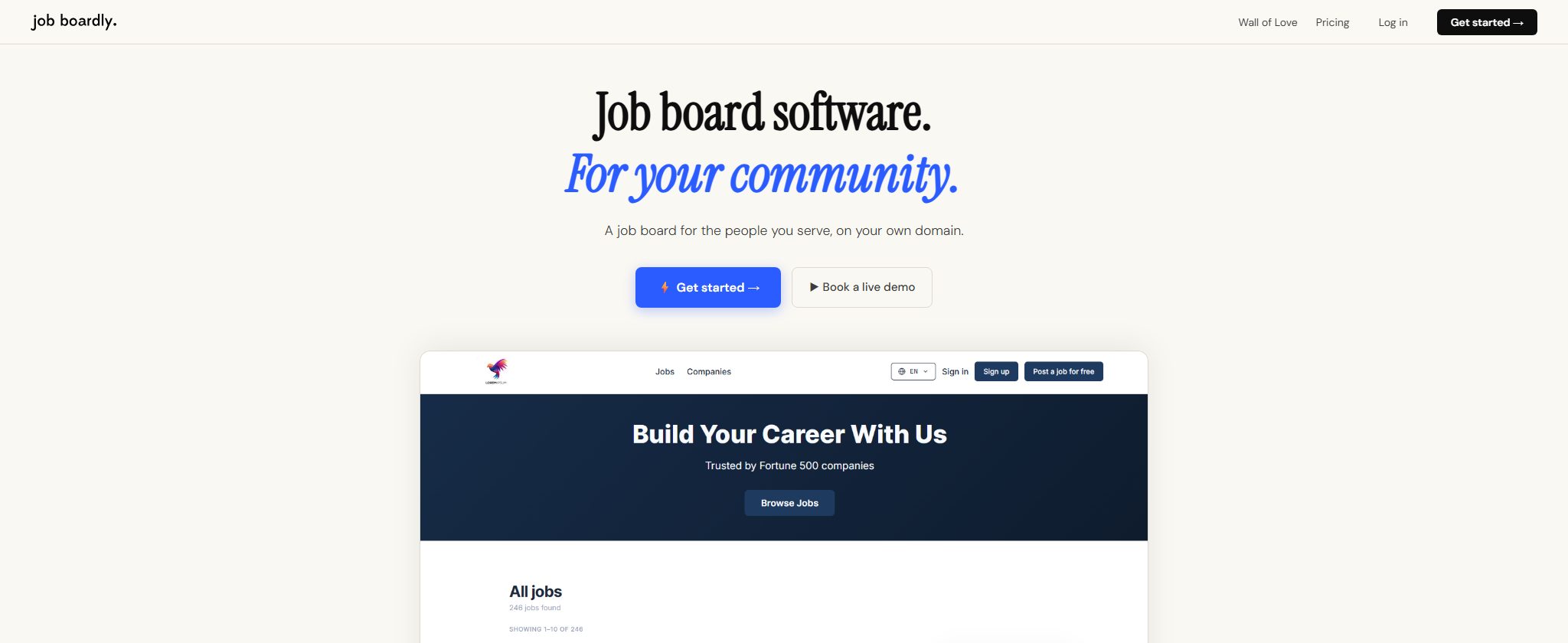
Job Boardly does the heavy lifting so you do not have to build or run your own scraper. The Job Aggregator imports jobs from the career pages, ATS pages, and structured feeds you point it at, while the Job Backfiller adds volume from a licensed API of millions of active listings. You get the data without managing proxies, fixing broken extractors, or babysitting brittle code yourself.
Job Boardly’s Job Aggregator
The Job Aggregator pulls job data from the sources you choose, whether that is a company career page, a public ATS page, or a structured REST or RSS feed. It routinely refetches listings to keep your board updated, standardizes key details such as job title, description, location, salary (in USD), posting date, and application URL, and removes duplicates by comparing attributes like job title, company, location, and external job ID.
Because Job Boardly builds and maintains the Job Aggregator for you, the upkeep that normally breaks DIY scrapers becomes our problem, not yours. Imports can run on a schedule, hourly or daily, with everything handled automatically. The Job Backfiller also gives you access to a database of 12M+ active listings, on a usage-based model, with credits sold as 1,000 credits for $12 ($0.012 each), 5,000 for $55 ($0.011 each), or 10,000 for $100 ($0.010 each) and valid for 12 months from purchase, so new boards can build inventory from day one.
But Job Boardly does not stop at importing jobs. It also provides a suite of tools to help you manage and monetize your job board effortlessly.
Features for Managing and Monetizing Your Job Board
Job Boardly comes packed with tools that make running and profiting from your job board a breeze. Features like paywalls, Stripe integration (in USD), the Job Backfiller, SEO tools, and customizable designs give you everything you need to create a successful niche platform.
- Paywalls: Restrict access to premium listings by showing summaries to the public while reserving full details, company names, or direct application links for paid subscribers.
- Stripe Integration: Charge employers for featured listings, subscription plans, or sponsored slots that appear prominently in search results.
- Job Backfiller: Automatically populate your board with relevant jobs from curated feeds, keeping your platform active while you grow direct relationships with employers.
Job Boardly also includes built-in SEO tools to help your board rank higher in search results. Using the structured data it collects, the system generates SEO-friendly URLs, meta descriptions, and JobPosting schema markup, making it easier for U.S.-based boards to rank for targeted queries like "remote React developer jobs in New York." Additional features like multi-language support, job alerts, and coupon codes ensure your board has all the functionality needed to attract users and generate revenue. With Job Boardly, launching and monetizing a niche job board has never been so straightforward.
How to Launch a Job Board Without Building Your Own Scraper
In 2026, creating a fully functional, monetized job board has become easier than ever. Thanks to no-code platforms and direct partnerships with employers, you can skip the cost and upkeep of building your own scrapers. This gives you a stable, scalable foundation for growth while keeping your data sources under control.
Using Job Boardly's No-Code Platform
Job Boardly simplifies the process of launching a job board, even if you have zero technical expertise. With its user-friendly no-code platform, you can sign up, pick a niche, and design your board using drag-and-drop tools. Add your logo, adjust brand colors, and set up a custom domain, all in a matter of hours.
One standout feature is Job Boardly’s Job Aggregator, which automates job imports for you. Monetization is a breeze with built-in tools like Stripe integration, paywalls, and options for featured listings. Plus, the platform includes SEO tools to help U.S.-based boards rank higher in search results, thanks to features like JobPosting schema markup and optimized URLs. Pricing starts at $50 per month, with backfill credits sold in bundles (1,000 credits for $12 ($0.012 each), 5,000 for $55 ($0.011 each), or 10,000 for $100 ($0.010 each)) and valid for 12 months from purchase. Compared with building and maintaining custom scraping tools, this is a cost-effective and hassle-free solution.
Partnering Directly with Employers and Job Boards
To make your job board stand out, direct partnerships with employers are key. These relationships give you access to exclusive job listings and help establish a reliable content pipeline. Start by reaching out to HR departments through email or LinkedIn, offering free initial postings to demonstrate the value of your platform. Once you’ve shown that your board attracts qualified candidates, you can negotiate ongoing agreements for direct job submissions or data feeds like XML or RSS.
You can also expand your listings by securing API access or forming affiliate partnerships with other job boards. Use tools like CSV or direct link importers to integrate structured data feeds from your partners. This method is far more dependable than DIY scraping, as it relies on mutual agreements rather than fragile technical solutions that can break whenever a website updates its layout.
When Scraping Might Still Make Sense in 2026
Even as managed aggregation takes center stage, there are still specific scenarios where scraping remains a practical option. Recognizing these situations can help you shape a smarter data strategy for your job board. Let’s explore when scraping might still be relevant and how to handle it responsibly.
Situations Where Scraping May Be Necessary
Scraping can be a go-to approach when dealing with small or older websites that don’t offer APIs or data feeds. Think of local businesses, university career pages, or municipal job portals. For instance, a job board focused on academic roles might need to scrape individual department websites that don’t share their job postings through broader syndication.
It can also be a short-term solution for new job boards. During the first 60 to 90 days, scraping can help populate listings while you work on building direct partnerships. In such cases, it’s more of a stopgap than a permanent strategy.
Another use case is internal market research. Companies often scrape data to analyze trends in skills demand, salary ranges, or competitor hiring activities. For example, the hiQ Labs v. LinkedIn case clarified that scraping publicly available data doesn’t violate the Computer Fraud and Abuse Act (CFAA), as long as no security measures are bypassed. However, the Meta v. Bright Data (2024) decision highlighted that scraping in violation of a site’s terms of service could still be seen as a breach of contract.
How to Minimize Risks When Scraping
Scraping comes with legal and technical challenges, so it’s essential to approach it cautiously. Here are some best practices to reduce risks:
- Respect Terms of Service: Avoid scraping websites that explicitly forbid automated access in their terms.
- Don’t Circumvent Barriers: Stay away from bypassing CAPTCHAs or login requirements.
- Control Request Rates: Limit your requests to just a few per minute per domain, adding random delays to avoid detection. Always follow robots.txt directives.
From a technical standpoint, keep your scrapers modular and well-documented. Building one extractor per site ensures that if a website changes its layout, you only need to adjust that specific module rather than overhauling your entire system. Additionally, establish clear data retention policies. Use scraped data for temporary purposes like seeding or internal analytics, and avoid permanent public redistribution. Lastly, include opt-out mechanisms so you can promptly remove content if a source requests it.
Conclusion: Building a Job Board in 2026
Building and maintaining your own job board scraper was once a common quick fix, but in 2026 it is usually more trouble than it is worth. Legal risks, constant website updates, and fragile code make DIY scraping unreliable and costly. The game has changed, and staying ahead means letting a managed tool do the work.
Managed aggregation is the way forward. Platforms like Job Boardly handle the scraping and licensed feeds for you and add built-in monetization tools, removing the headaches of running your own scrapers. With this approach, your job board can thrive in a competitive and ever-evolving market.
The choice is clear: build your job board on a solid, future-proof foundation with managed aggregation and no-code tools. In 2026, success in the job board space means prioritizing sustainability and reliability. It is not just about avoiding risks. It is about making smarter, long-term decisions for your business.
FAQs
What legal risks should you consider before scraping job boards?
Scraping job boards comes with its share of legal risks. It can potentially violate copyright laws, breach terms of service agreements, or infringe on intellectual property rights. On top of that, collecting data without permission or interfering with a website’s normal functionality might lead to lawsuits or hefty fines.
To steer clear of these issues, it’s essential to familiarize yourself with the legal framework and follow the rules to ensure your activities remain compliant.
What are the key differences between API-based job aggregation and traditional web scraping?
API-based job aggregation is a smarter, more dependable alternative to traditional web scraping. Unlike web scraping, which pulls data from HTML and can easily break when websites update their structure, APIs deliver structured, reliable data directly from the source. This approach significantly cuts down on maintenance headaches.
Another advantage of APIs is that they often include clear legal compliance and usage guidelines, making them a safer and more sustainable choice over time. Many modern job boards now lean toward API-based methods because they provide consistent performance, minimal disruptions, and a seamless experience for both operators and users.
When might job board scraping still be useful in 2026?
Scraping could still play a role in 2026, especially when direct access to job data is limited by platform restrictions, paywalls, or the absence of APIs. It can also be a valuable tool for collecting listings from niche or emerging markets where advanced aggregation tools may not yet cover everything.
Although scraping might not always be the first choice, it can serve as a practical workaround for accessing difficult-to-reach data or filling gaps in job aggregation when no other alternatives are available.
What is a job board scraper?
A job board scraper is an automated tool or script that extracts job listings (titles, descriptions, salaries, and apply links) from career sites and other job boards. Options range from no-code scraping APIs like ScraperAPI or Apify to open-source job scraping libraries such as JobSpy, or fully custom code. They all work to a point, but break when sites change, raise Terms-of-Service and copyright issues, and need ongoing proxy and CAPTCHA maintenance. Many job board operators use managed aggregation instead.
Is job scraping legal?
Job scraping sits in a legal grey area. Scraping publicly available data may not breach the US Computer Fraud and Abuse Act (per hiQ Labs v. LinkedIn), but doing it against a site’s Terms of Service can still count as breach of contract (Meta v. Bright Data, 2024), and collecting personal data can trigger GDPR or CCPA penalties. Pulling listings from authorized APIs and data feeds avoids this uncertainty.
Before you go: launch your
job board in 10 steps
Get the free interactive checklist + insider tips on building a profitable job board sent to your inbox.