When creating a job board, you’ll need to decide between job board themes and job board software. Here’s the quick takeaway:
- Job Board Themes: Affordable, easy to set up, and ideal for small-scale or low-traffic projects. However, they can lead to long-term issues like plugin conflicts, slow performance, and limited scalability.
- Job Board Software: Built specifically for job boards, offering integrated features like SEO, monetization, and high scalability. While the upfront cost is higher, it’s a better choice for long-term growth and reliability.
Key Differences:
- Cost: Themes are cheaper upfront (around $39–$97), while software often starts at $50/month.
- Setup: Themes require plugins and manual updates; software handles everything for you.
- Scalability: Themes struggle with high traffic; software is designed to grow with your business.
- SEO: Software includes built-in SEO and Google Jobs integration, while themes may require additional tools.
If you’re just testing an idea or working on a small project, themes are a good starting point. But for a serious, scalable business, job board software is the smarter investment.
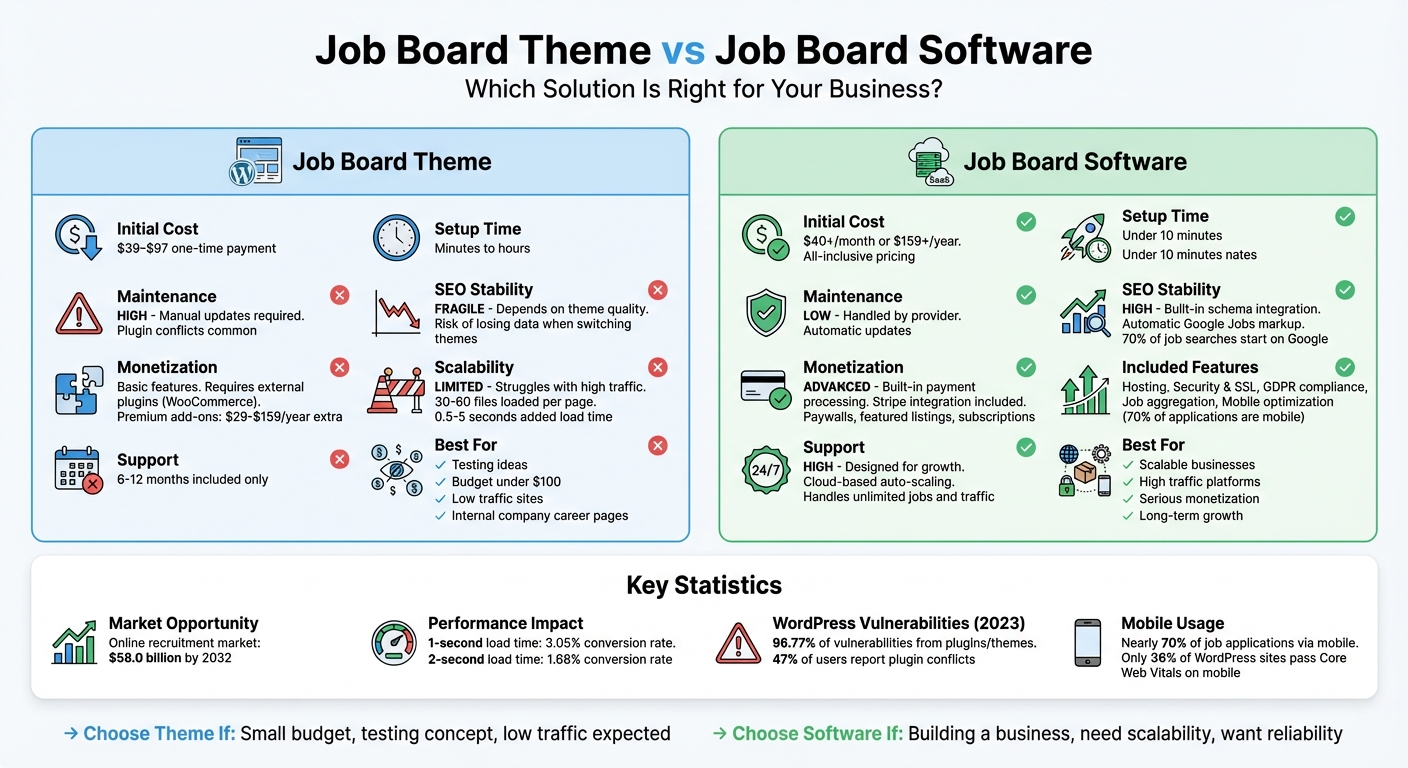
Job Board Theme vs Job Board Software: Complete Feature and Cost Comparison
What Is a Job Board Theme?
Definition and Features
A job board theme is essentially a pre-designed template, often used with WordPress, that transforms a website into a fully functional job portal. It takes care of both the look and basic functionality of the site. If you're shopping for one, see our roundup of the best job board templates to compare specific options.
These themes handle the front-end elements like layout, styling, search bars, and filtering systems, all bundled into a single installation. Some themes offer "all-in-one" solutions, while others work as a visual layer paired with plugins like WP Job Manager - a tool trusted by more than 100,000 websites. To add specialized features such as payment processing (via WooCommerce) or search engine optimization, additional plugins are often required.
"Plugins are used to extend the core functionality of WordPress and themes are used for the presentation (layout and styling) of the website." - Fellowship Agency
Job board themes integrate seamlessly with WordPress's dashboard, enabling users to manage job listings, applications, and resumes without needing coding skills. Common features include advanced search filters, location-based mapping, front-end submission forms, and dedicated dashboards for employers and job seekers.
This combination of design and functionality makes these themes a go-to choice for entrepreneurs looking for a cost-effective solution.
Why Job Board Themes Are Popular
The popularity of job board themes boils down to their affordability and ease of use. You can set up a functional job portal in just a few hours, often for less than $100 - a fraction of the cost of custom-built solutions.
"Off-the-shelf WordPress themes allow you to install standard front-end design on your website for free, or for a nominal fee. You don't need coders, you don't need designers... something quick and cost-effective." - Ben May, Managing Director, The Code Company
This makes them perfect for testing the waters in a specific niche without committing to expensive infrastructure. Plus, WordPress's widespread use means you can quickly import pre-designed demos and start accepting job listings almost immediately - no technical know-how required. This speed is often achieved by backfilling your job board with existing listings to ensure the site doesn't look empty on day one.
How to Create a Job Board Website with WordPress & Superio Theme | WordPress job website 2024
Where Job Board Themes Break Down
Themes often lure users with their affordability and quick setup, but they can become a stumbling block as your site grows. What starts as a cost-effective solution can quickly turn into a maintenance headache when traffic increases and business needs evolve. Let’s dive into the key problem areas, starting with plugin dependency and conflicts.
Plugin Dependency and Conflicts
Most job board themes act as a visual layer on top of a core plugin like WP Job Manager and often rely on multiple third-party add-ons for features like paid listings, resume management, or email alerts. The issue? These plugins are developed independently. So, when WordPress or the primary job board plugin updates, it can cause compatibility problems. Fixing these issues often requires a developer, leading to higher maintenance costs.
"The business model behind most [premium themes] is design and flexibility that compromises stability, speed, or security."
- Mario Peshev, CEO, DevriX
As your job board grows, the accumulation of plugins can slow down your site, dragging down page load times and frustrating users.
Fragile SEO and Google Jobs Integration
Off-the-shelf themes often come bloated with unnecessary features, which can hurt your PageSpeed scores and SEO rankings. Worse yet, many themes bake SEO functionality directly into their code instead of relying on dedicated plugins. This means switching themes later could result in losing essential SEO data and custom taxonomy structures.
If your job board relies on visibility in Google Jobs, things get even trickier. Google Jobs requires Schema.org "JobPosting" structured data, and without reliable, automated integration for this markup, your listings might not show up in Google's job search results. Even small code changes in a complex theme can disrupt this integration, potentially leading to SEO penalties. Given that 96.55% of pages get no traffic from Google (per Ahrefs' 2023 study of ~14 billion pages) and that billions of searches happen on Google daily, these technical flaws can severely limit your reach.
"We believe it's an unnecessary risk to have superfluous code on your site that could get you dinged by Google, stalling your long-term growth."
- The Code Company
Monetization Challenges
setting up paywalls, featured listings, or subscriptions with Stripe with themes often requires heavy plugins like WooCommerce. While these tools are powerful, they add complexity to pricing management and reporting, making it harder to maintain a smooth user experience. For instance, premium add-ons for WP Job Manager start at $29 per year, with bundles costing up to $159 annually. If you need multiple extensions, these costs can quickly add up.
Beyond the expense, coordinating updates across payment systems, job postings, and listing tools often creates a fragmented experience, leading to manual errors in financial reporting. This makes monetization more of a headache than it should be.
Aggregation and Distribution Limitations
Themes also fall short when it comes to managing external job sources. Unlike purpose-built software, they lack the robust integrations needed to pull job listings from external platforms or distribute them to third-party sites. To compensate, you might have to rely on multiple plugins and workarounds - each with its own limitations and potential for conflicts.
Scaling and Performance Issues
Premium themes often make numerous database checks per page load to retrieve configuration settings. As traffic grows, this overhead can strain your server, limiting the number of users your site can handle at once. Although modern browsers can handle up to 8 simultaneous file requests, many premium themes load 30–60 styles, scripts, and icons, adding anywhere from 0.5 to 5 seconds to page load times. For a job board, where application conversion rates range from just 0.1–2%, slow loading speeds can significantly hurt your bottom line.
Slower websites also consume more server resources, meaning you’ll spend more on hosting while supporting fewer users. Over time, the total cost of maintaining a theme-based job board - including fixing plugin conflicts, managing downtime, and applying updates - can surpass the cost of using specialized software. Non-technical founders may find themselves spending more time wrestling with tech issues than actually growing their business.
What Is Job Board Software?
Definition and Characteristics
Job board software is a dedicated, fully hosted platform designed specifically for running recruitment websites. Unlike WordPress themes that require multiple plugins and extensions to function, job board software provides an all-in-one solution. Infrastructure, security, and other essential components are built into the platform, eliminating the need for extra add-ons.
These platforms are designed for simplicity, offering a no-code setup that can have your job board up and running in as little as 30 seconds to 10 minutes. Routine maintenance tasks like SSL certification, GDPR compliance, and software updates are handled by the provider as part of a monthly subscription. With the online recruitment market expected to hit $58.0 billion by 2032, this type of software is built to support rapid scaling from the start. It offers a robust foundation with features tailored for growth, as outlined below.
Key Features of Job Board Software
Job board software comes packed with features that make it easy to manage and grow a recruitment platform:
- Monetization and Aggregation: Platforms integrate tools like Stripe for seamless payment processing, enabling you to charge for job postings instantly. Features include paywalls, highlighted listings, and subscription options. Automated job aggregation pulls fresh listings from major platforms, keeping your board active without requiring manual updates.
- SEO and Visibility: Built-in Google Jobs Schema integration ensures your job postings appear in search results automatically. This is especially important given that about 70% of job searches begin on Google. This automated optimization boosts your board's visibility without additional effort.
- User Experience: Features like employer and candidate dashboards, advanced filters for location and salary, and mobile-friendly design come standard. Considering nearly 70% of job applications are submitted via mobile devices, these features are essential for a smooth user experience.
Job Boardly is a great example of this approach, combining monetization tools, job aggregation, SEO optimization, Stripe integration, and customizable designs - all without requiring any coding knowledge. The platform even supports multiple languages and provides the infrastructure needed to launch and grow a niche job board. These built-in features highlight its advantages compared to the limitations of traditional job board themes.
Job Board Theme vs Job Board Software: Side-by-Side Comparison
Comparison Table
Here’s a quick look at how job board themes stack up against job board software:
| Feature | Job Board Theme | Job Board Software |
|---|---|---|
| Initial Cost | $39–$97 one-time | $400+/year or $50+/month |
| Setup Time | Minutes to hours | Minutes (under 10) |
| Maintenance | High (manual updates, plugin conflicts) | Low (handled by provider) |
| SEO Stability | Fragile (depends on theme quality) | High (built-in schema integration) |
| Monetization | Basic (requires external plugins) | Advanced (built-in payment processing) |
| Scalability | Limited (drops with high traffic) | High (designed for growth) |
| Support | 6–12 months included | Ongoing with subscription |
With job board themes, you’re responsible for hosting, managing security certificates, ensuring GDPR compliance, and keeping plugins updated. On the other hand, job board software takes care of these tasks for you as part of the subscription, reducing the technical workload. This comparison highlights not only the upfront differences but also how ongoing costs and maintenance can vary significantly over time.
Cost and Maintenance Over Time
At first glance, job board themes seem like the budget-friendly option. But over time, the hidden costs start to add up. Expenses like hosting, domain registration, and SSL certificates aren’t included, and when compatibility issues arise - like a plugin conflict or a problematic theme update - you’re the one left troubleshooting.
Job board software, by contrast, simplifies things with all-inclusive pricing. Your subscription typically covers hosting, security, updates, and support. This predictability makes budgeting easier, which is a big deal for founders trying to avoid unexpected expenses. Plus, the reduced maintenance burden lets you focus on growing your platform rather than firefighting technical issues. These differences directly influence your ability to scale efficiently.
Scalability and Growth Potential
Themes are fine for small-scale job boards with minimal traffic, but they start to falter as your platform grows. Increased traffic means higher hosting costs, more frequent technical issues, and performance slowdowns. Themes often come with excessive code overhead, which can bog down your site, especially when you’re managing hundreds - or even thousands - of job listings. Slower page loads and lagging search features can frustrate users, particularly mobile ones. Considering that nearly 70% of job applications are submitted via mobile devices, these issues can hurt your conversion rates.
"A bloated code base that's compatible with a wide range of plugins and outside services means even small code changes can break the whole build in unexpected ways." - Ben May, Managing Director, The Code Company
Job board software is designed to handle growth from the start. Platforms like Job Boardly are optimized for recruitment sites, allowing them to manage unlimited jobs and traffic seamlessly. For example, major job boards like Indeed - processing over 10 job applications every second - rely on purpose-built software rather than WordPress themes. If you’re planning to scale beyond a handful of listings per month, investing in dedicated software ensures you won’t face the hassle of rebuilding your platform later. It’s a future-proof solution that supports growth without compromising performance or user experience.
When a Job Board Theme Makes Sense
For Low-Traffic or Simple Projects
Job board themes shine when you're managing a straightforward project with minimal complexity. For instance, if you're setting up an internal career page for your company, a theme can offer a complete, hassle-free solution. As Will Morris explains:
"If you're just posting job listings for your own company, [monetization] may be less important... a job board theme can make the process much easier."
Themes also work well for niche communities where you already have an engaged audience. Say you run a blog or a membership site focused on a specific field - like freelance writing or local trades. Adding a job board through a theme can enhance your site's value without requiring a complete overhaul. If you're experimenting with a proof-of-concept, themes allow you to gauge user interest before committing to a bigger investment.
For Limited Budget and Technical Scope
If you're working with a tight budget, job board themes are a cost-effective solution. You can launch a functional site for under $100, which is a fraction of the cost of custom development - typically ranging from $2,500 to $15,000.
Themes are also a great choice if you're not tech-savvy. Most job board themes come with user-friendly tools like drag-and-drop builders or the WordPress Customizer, making it easy to tweak colors, fonts, and layouts without touching a single line of code. As Mario Peshev, CEO of DevriX, puts it:
"The benefit is that you see a beautiful demo (or several demos) that seem to solve your need, and the cost is drastically lower than hiring a designer and a developer to build a custom theme for you."
However, it's important to weigh the trade-offs. Themes are ideal for projects with low traffic, monetization strategies, and occasional maintenance requirements. They're perfect for low-risk, smaller-scale projects. On the other hand, if your platform grows and demands more robust features, you'll likely need to transition to dedicated job board software to handle the increased complexity.
When Job Board Software Is the Better Choice
Scalable and Reliable Infrastructure
Job board software offers a level of stability and scalability that themes often can't match. If you're serious about building a job board as a full-fledged business, you need infrastructure that can handle growth without hiccups. Dedicated job board platforms leverage cloud-based hosting with automatic scaling, ensuring your site can handle traffic spikes without slowing down or crashing.
The difference can be night and day. Take Melissa Williams from the Truckee Chamber of Commerce, for example. She shared her frustration with a WordPress plugin-based job board:
"A major challenge was that we had 40,000 spam users… So on the previous job board with a WordPress plug-in I was spending a lot of time just trying to get rid of spam. It was a nightmare."
Managed job board software eliminates these headaches by taking care of updates, security patches, and server maintenance. This means less time spent troubleshooting and more time focusing on what matters. David Tierney from Medical Alley Association explained how switching to managed software significantly reduced his workload:
"I maybe spend 10-15 minutes a day on the job board right now, whereas previously it was probably two to three hours a week. It's probably three to four times less time spent now."
With a reliable system in place, you can shift your focus to growing your platform and making it profitable.
Advanced Monetization and Aggregation
Themes often require multiple plugins to handle payments and revenue generation, which can lead to a fragmented and clunky experience. In contrast, software platforms streamline these processes. They integrate tools like Stripe for smooth payment handling and automate job aggregation, making it easy to implement revenue models such as featured listings, pay-per-post options, or subscription paywalls - all without manual intervention.
Once your platform's performance and revenue streams are optimized, the next step is ensuring it gets noticed.
SEO and Google Jobs Optimization
Job board software doesn't just perform well; it also helps your listings stand out. These platforms automatically generate JobPosting schema markup for every listing, a crucial factor for appearing in Google for Jobs results.
Speed also plays a huge role in conversions: conversion rates drop sharply as load time climbs past the first second or two. Unlike themes with bloated, generic code, job board software maintains lean, fast-loading codebases. As Ben May, Managing Director of The Code Company, explains:
"A serious publishing business needs a tech stack built for its specific needs and goals. Reducing upfront costs by using an off-the-shelf theme can hamstring you down the line on everything from page speed to SEO."
Additionally, software platforms automate the handling of expired job listings by setting up proper redirects. This prevents thousands of 404 errors, a common issue with manual setups, and protects your SEO efforts.
Why Founders Switch From Themes to Job Boardly

Common Triggers for Switching
For many founders, the decision to move away from theme-based job boards often comes down to mounting frustrations and hidden costs. Managing a job board built on themes can feel like an uphill battle, especially when plugin conflicts crop up. Plugin conflicts are a common complaint, and an update can break a live site without warning. These challenges highlight the limitations of theme-based platforms, pushing founders to explore better options.
Security issues are another major concern. In Patchstack's 2023 State of WordPress Security report, plugins accounted for 96.77% of new WordPress vulnerabilities and themes for roughly another 3% - nearly all of them. Add to that the performance struggles many WordPress sites face passing Google's Core Web Vitals on mobile, and it becomes clear why founders reconsider their setup. Even if your job board ranks well, slow load times can hurt both conversions and SEO progress.
Then there are the unexpected expenses. A $59 theme might seem like a bargain initially, but the costs quickly add up. Premium add-ons for features like resume management, applications, and SEO tools can drive annual costs into the hundreds. And that’s before factoring in the time spent troubleshooting.
How Job Boardly Solves These Issues
To tackle these recurring headaches, many founders turn to Job Boardly - a platform designed to simplify operations and eliminate technical roadblocks. Job Boardly combines all the essential tools into one cohesive system. Say goodbye to plugin conflicts; features like Job Aggregator and Job Backfiller automate job aggregation, while built-in SEO and Google Jobs integration handle schema markup for every listing automatically.
Monetization is also seamless. With Stripe integration, paywalls, and featured listings ready to go, there’s no need for extra extensions or workarounds.
And the cost? At $50/month or $400/year, Job Boardly provides a fully hosted platform with automatic scaling, security updates, and maintenance included. This setup not only resolves the technical challenges but also frees up time, letting founders focus on growing their business instead of wrestling with constant fixes.
Conclusion
If you're working on a proof-of-concept and have a tight budget under $100, starting with a WordPress theme can be a quick and affordable way to test your idea. It’s a practical choice to gauge whether your content connects with an audience without making a significant financial commitment.
However, when it comes to building a scalable business, the limitations of off-the-shelf themes quickly become obstacles. As Ben May points out, these themes often come with bloated code, plugin conflicts, fragile SEO, and rising maintenance costs that can drain your time and resources - time better spent focusing on growth. These challenges highlight the need for a more robust solution.
That’s where Job Boardly steps in to remove these bottlenecks. For $50/month or $400/year, it offers a fully hosted platform with automatic updates, built-in SEO, Google Jobs integration, Stripe payment processing, and powerful aggregation tools - all without requiring any coding. This setup allows you to focus on scaling and monetizing your business seamlessly.
The online recruitment market is projected to reach $58.0 billion by 2032, presenting a huge opportunity for founders who choose the right tools from the start. Whether you're testing the waters or aiming to build a scalable business, investing in the right technology early on can save you from costly rebuilds down the road. Your choice of platform should drive your growth - not hold it back.
FAQs
What are the advantages of using job board software instead of themes?
Job board software delivers a dedicated, all-in-one solution that sidesteps the common limitations of themes. While themes often rely on multiple plugins and extensive customizations, job board software packages essential features - like paywalls, job aggregation, SEO tools, Stripe integration, and multilingual support - into a single platform. This not only minimizes the risk of plugin conflicts but also ensures smoother performance as your job board expands.
Another major advantage is that hosting, security, and scaling are all handled for you. This allows you to focus on growing your business rather than dealing with technical headaches. While themes might appear more budget-friendly and quicker to set up initially, they often become a hassle as traffic grows, leading to higher costs and operational challenges in the long run. Job board software offers a reliable, scalable, and efficient solution tailored to support your growth.
How do plugin conflicts impact the performance of job board themes?
Plugins can be a double-edged sword for job board themes. While they add essential features like payment gateways, SEO tools, or job listing capabilities, they can also cause serious problems when they don’t play nice together. Conflicts between plugins can lead to issues like duplicate scripts, increased server load, or even broken features. The result? Sluggish page speeds, missing job listings, or, in worst cases, site-wide crashes.
As your traffic grows, these conflicts become even more problematic. They can drag down your site's performance, hurt SEO rankings, and frustrate users - making it harder to scale effectively. While themes might seem like a quick and budget-friendly solution, their reliance on multiple plugins can often end up being a major roadblock to the growth of your job board.
Why is SEO important for job boards?
SEO plays a crucial role for job boards by ensuring your listings show up in search engine results, which naturally draws in both job seekers and employers. Given that job postings often have a short lifespan, strong SEO practices help maintain a steady flow of traffic by improving your site's visibility and making it easier for users to find.
To achieve this, job board SEO relies on specific strategies like using structured data, enabling real-time indexing, and crafting optimized content. These techniques not only help sustain rankings but also support the long-term growth of your platform. Without integrating effective SEO, it can be challenging for your job board to expand and reach its full audience potential.