Job posting software means two different things, and picking the wrong category wastes both money and time. Most people searching for it are employers who want to publish one opening across many job sites at once — that's multiposting, usually bundled into an applicant tracking system (ATS). But a second group wants jobs posted on their own website: an association job bank, a university careers hub, a community or niche job board. That's a different tool category entirely.
This guide covers both. Tools 1–7 are for employers distributing openings outward; the final section covers running a board of your own, where the jobs come to you.
| Tool | Best for | Job distribution | Pricing |
|---|---|---|---|
| ZipRecruiter | Raw reach, one role at a time | 100+ job sites | Quote-based, per job slot |
| Workable | Full ATS + broad distribution | 200+ job boards | From $299/month |
| Breezy HR | Starting free | Multiple free boards | Free; paid from $157/month |
| JazzHR | Budget SMB hiring | Free board syndication | From $1,000/year |
| CareerPlug | Franchises and multi-location SMBs | Major boards | Quote-based |
| Team Engine | Field and deskless workforces | Multiple boards + texting | From $500/month |
| x0pa AI | Enterprise AI recruiting | Advertised 2,000+ boards | From $28,000/year |
1. ZipRecruiter
Best for: maximum reach on a single opening without managing multiple accounts.
ZipRecruiter is the best-known name in multiposting: publish once and your opening is distributed to 100+ job sites, with AI matching that invites likely candidates to apply. It's built around speed and volume rather than pipeline management — some ATS features are available, but distribution is the product.
- Distribution: one posting syndicated to 100+ job sites, plus candidate matching from its resume database.
- Pricing: not published — every employer gets a custom quote, billed per active job slot, with paid boosts extra. The free trial is short (days, not weeks) and requires a card.
- Watch for: per-job-slot billing adds up fast if you hire continuously; it's priced for filling a role, not for always-on hiring.
2. Workable
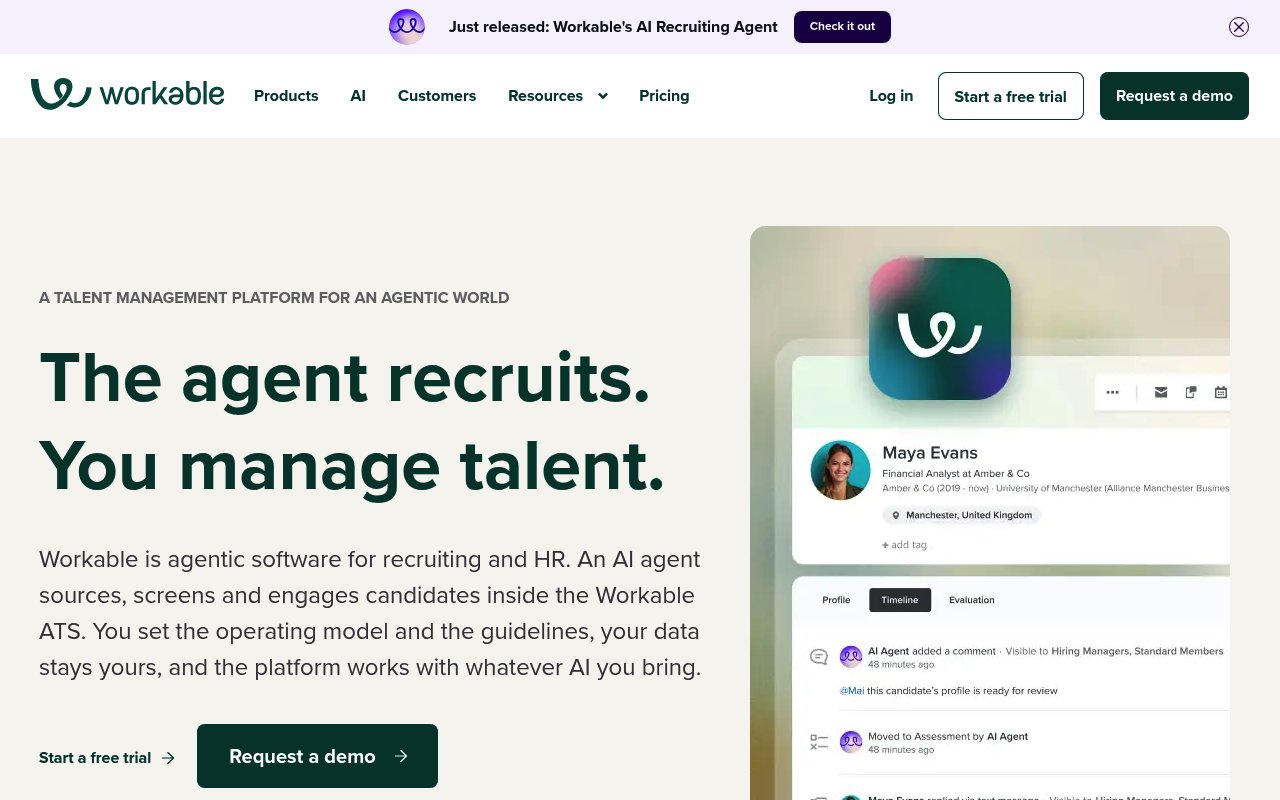
Best for: teams that want broad board distribution inside a full ATS.
Workable pairs a 200+ job board distribution network with a complete recruiting suite: pipeline management, AI sourcing, a careers page builder, and HR tools like onboarding and time-off tracking. It's the strongest all-in-one option here if you hire regularly.
- Distribution: 200+ job boards, plus a careers page builder, website jobs widget, and LinkedIn/Indeed integrations.
- Pricing: Standard starts at $299/month for the smallest company size, with unlimited active jobs (subject to Workable's fair-usage limits); higher tiers run $599–$719/month. Pricing scales with company headcount, not usage.
- Watch for: headcount-based pricing means the quoted figure grows as your company does, even if hiring volume doesn't.
3. Breezy HR
Best for: testing multiposting for free before committing to a subscription.
Breezy HR is a friendly, visual ATS whose permanently free Bootstrap plan covers one active position distributed to multiple free job boards — the lowest-risk way on this list to see what syndication actually returns for your role and market.
- Distribution: openings pushed to a set of free job boards, with premium board promotion available on paid tiers.
- Pricing: Bootstrap is free (one active position, 30-day candidate data retention). Startup runs $189/month, or $157/month billed annually; higher tiers at $329 and $529/month. All paid plans include unlimited users.
- Watch for: the free tier's 30-day data retention and missing email/scheduling integrations make it a trial in practice, if not in name.
4. JazzHR
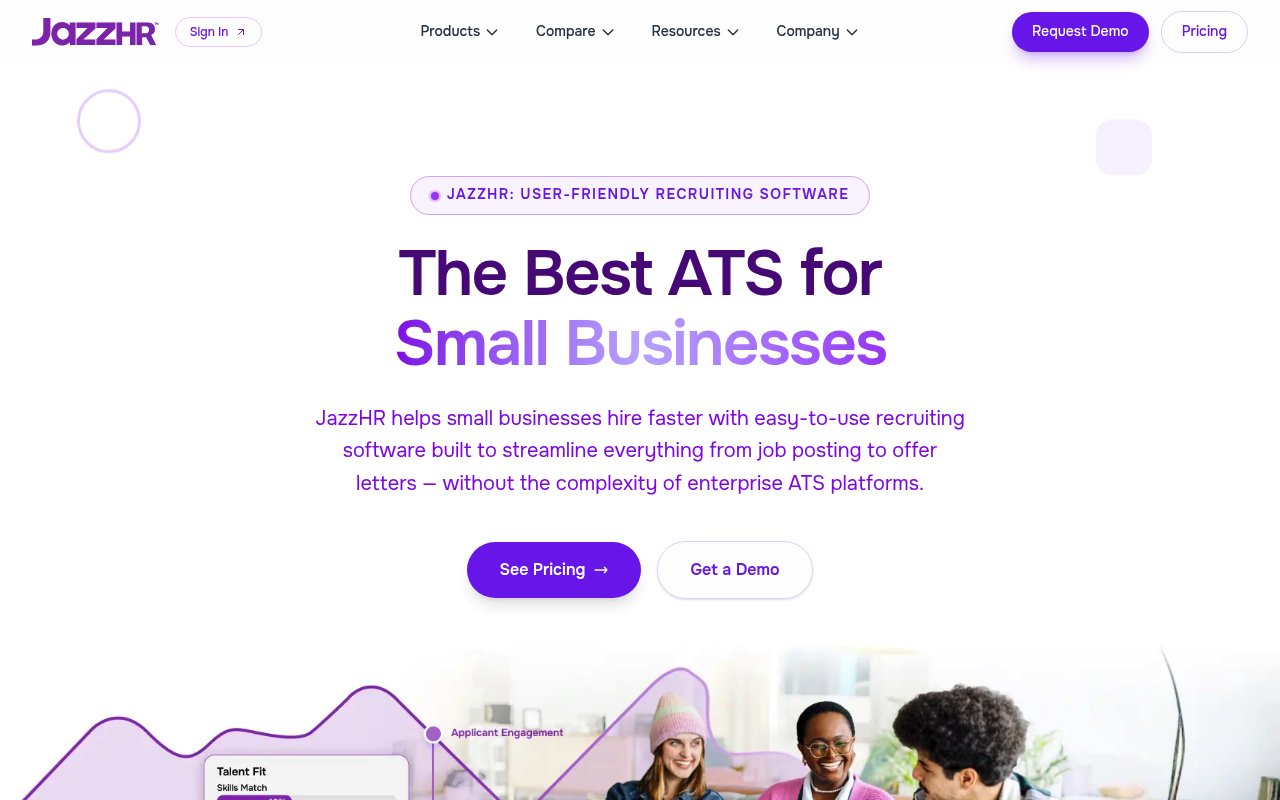
Best for: small businesses that hire a few roles at a time and want flat, published pricing.
JazzHR is the budget pick among real ATSes: its Hero plan syndicates jobs to free boards at a price most small teams can absorb. The trade-off is caps and add-ons — the entry tier is deliberately snug.
- Distribution: syndication to free job boards, with paid board integrations on higher tiers.
- Pricing: Hero at $1,000/year (about $83/month) includes job postings starting at 3 per month, per JazzHR's published rate card (July 2026); Plus and Pro run $3,480 and $5,508/year. Those are annual-billing rates — monthly billing costs more (JazzHR says paying yearly saves up to 24%). Texting, e-signature, and advanced reporting are paid add-ons on lower tiers.
- Watch for: Hero starts at 3 job postings a month — if you routinely run more openings, price the Plus tier (up to 200 active jobs), not Hero.
5. CareerPlug

Best for: franchises and multi-location businesses hiring hourly roles.
CareerPlug focuses on making hiring repeatable for owners who aren't recruiters: template job postings, automatic distribution to major boards, and built-in screening questions that filter applicants before a human reads them. It's especially established in the franchise world, where the same role gets hired again and again across locations.
- Distribution: automatic posting to major job boards with pre-built templates per role type.
- Pricing: quote-based across three plans (Limited, Hire, Grow) with a 12-month commitment; no public rate card.
- Watch for: sales-led pricing means comparing it against published-price rivals takes a demo call.
6. Team Engine

Best for: field, trade, and deskless workforces where candidates live in text messages, not email.
Team Engine combines job board distribution with two-way texting as the primary channel — a fit for landscaping, construction, logistics, and similar industries where email-first ATSes quietly lose candidates. It also keeps engaging employees after the hire, which is unusual for this category.
- Distribution: postings across multiple job boards, with automated text outreach to applicants.
- Pricing: Essential at $500/month and Pro at $800/month (both billed annually), sized by employee count; custom pricing above 500 employees.
- Watch for: pricing is sized for operational workforces — it's overkill for a five-person office team.
7. x0pa AI
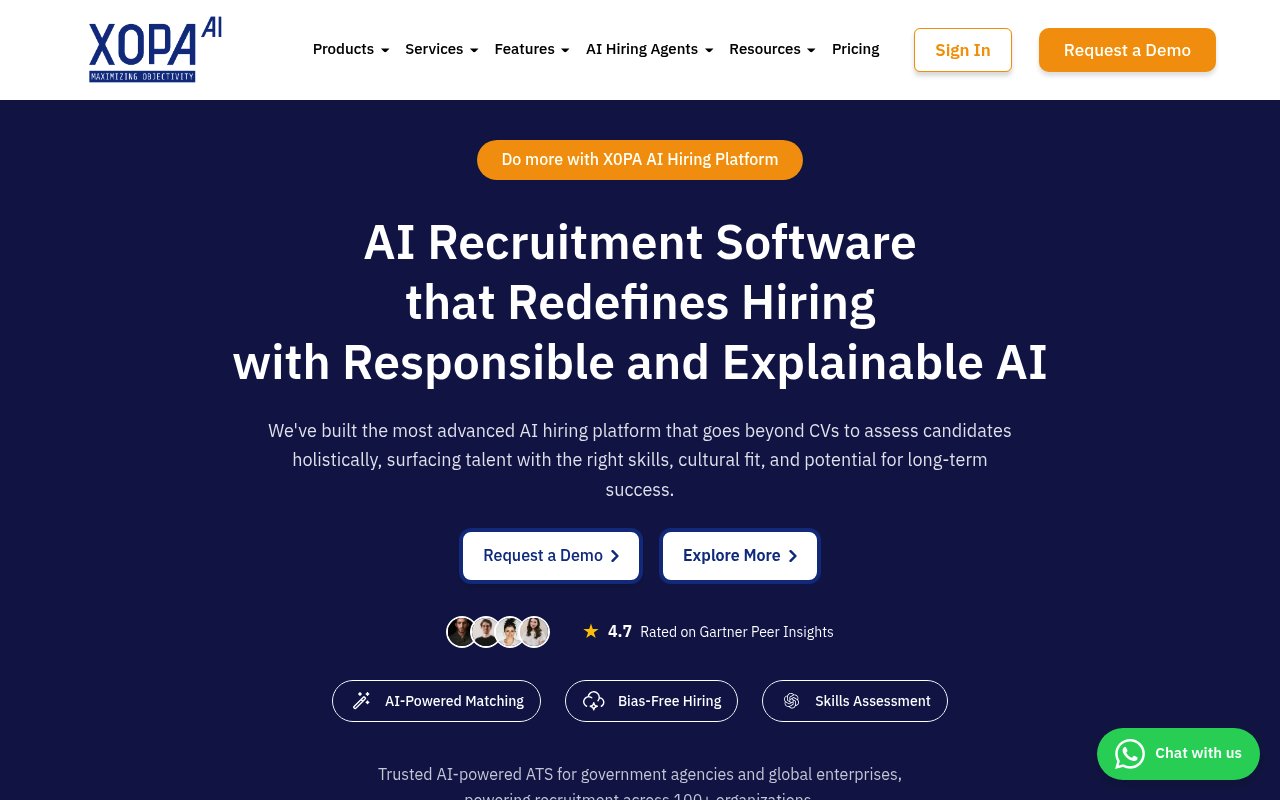
Best for: enterprises and public-sector teams automating high-volume recruiting end to end.
x0pa AI is an enterprise recruiting platform where automated job posting is one module among many: robotic process automation cross-posts openings across channels, and AI scoring ranks the resulting applicants. It competes with enterprise ATS suites, not with the SMB tools above.
- Distribution: automated cross-posting via RPA, with an advertised reach of 2,000+ candidate boards, inside a broader AI hiring suite.
- Pricing: published annual plans — AI Recruiter Core at $28,000/year (5 seats), Scale at $58,000/year (10 seats), and Elevate at $110,000/year (20 seats).
- Watch for: enterprise-scale pricing and onboarding; small teams will get more from Workable or JazzHR.
When Job Posting Software Is the Wrong Tool: Posting Jobs on Your Own Website
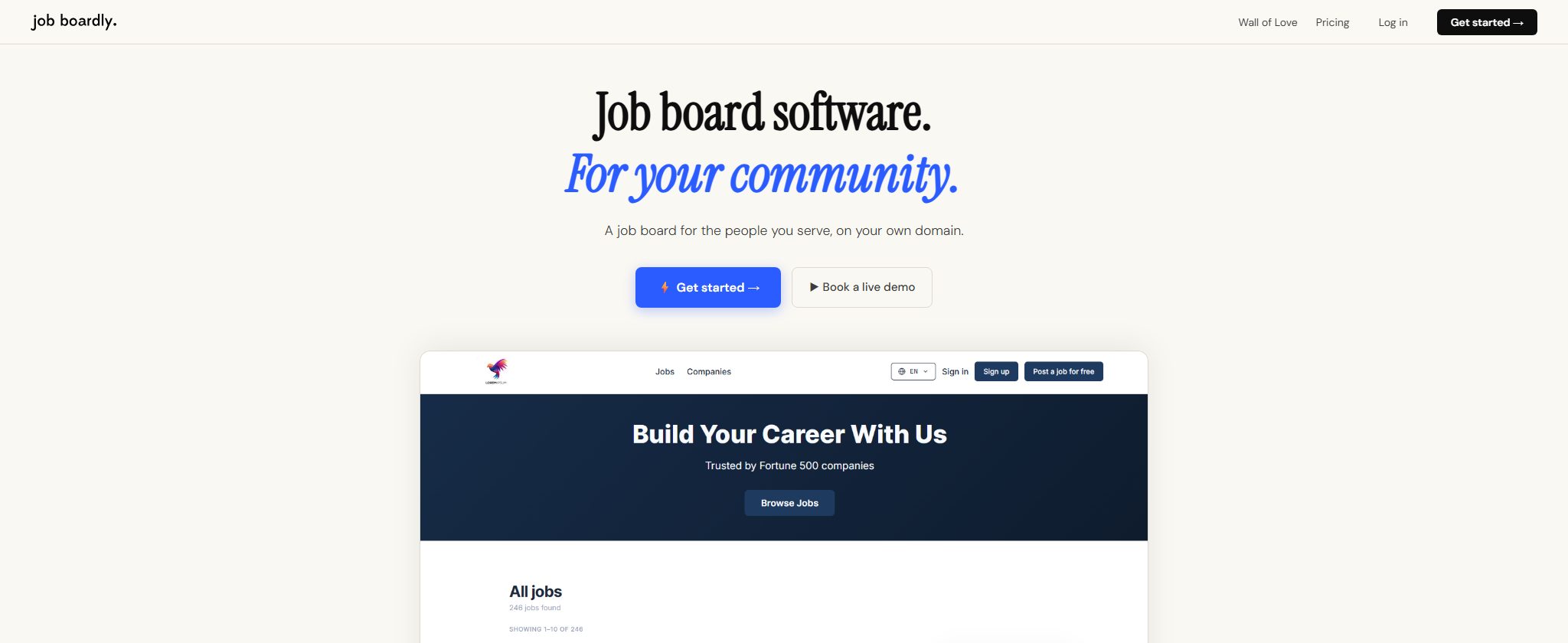
Everything above pushes your opening onto other people's websites. But a lot of "job posting software" searches are really asking the opposite question: how do I get jobs posted on my site? Associations running a member job bank, chambers of commerce, universities, staffing firms, and community builders all fit here — and for them, an ATS subscription solves nothing. For an association, a job board can also be a source of non-dues revenue, because employers pay to reach its members.
What that job needs is job board software: a platform that gives you a branded board where employers post (and pay for) listings. Job Boardly is built for exactly this:
- Your site, your brand: a hosted board on a custom domain, customized in a visual theme builder — live in an afternoon, no code.
- Google for Jobs, built in: every listing ships with the JobPosting schema markup Google requires, and the Google Indexing API requests faster crawling of new listings — making postings eligible to appear in Google's job search with no extra setup, the visibility employers are paying the tools above for.
- Never launches empty: the Job Backfiller seeds your board from a database of 12M+ active listings matched to your niche.
- Revenue, not spend: paid postings, employer subscriptions, and a candidate paywall via Stripe — the monetization models that turn a board from a cost into a business.
- Pricing: $60/month Standard, $120/month Pro, $240/month Ultra — flat, published, and not scaled by headcount or job slots. Each plan includes a monthly allowance of Job Backfiller and Job Aggregator imports (1,000 on Standard, 2,000 on Pro, 5,000 on Ultra); imports beyond that draw on credits, sold as 1,000 credits for $12 ($0.012 each), 5,000 for $55 ($0.011 each), or 10,000 for $100 ($0.010 each).
A useful test: if you're filling your own openings, pick from tools 1–7. If other people's openings should appear on your site, you want a job board platform.
How to Choose Job Posting Software
- Match the billing model to your hiring rhythm. Per-job-slot pricing (ZipRecruiter) suits occasional hires; flat subscription plans (Workable, JazzHR) win once hiring is continuous.
- Distribution breadth isn't quality. 200 boards beats 100 only if the extra hundred carry your candidates. For niche roles, one strong niche job board often outperforms broad syndication.
- Count the caps and add-ons. Entry tiers cap active jobs (JazzHR's 3) or strip features into add-ons; price the tier you'll actually need, not the headline number.
- Check how pricing scales. Headcount-based pricing (Workable, Team Engine) grows with your company even when hiring doesn't.
- Confirm which side of the desk you're on. Distributing your openings is an ATS problem; hosting everyone else's is a job board problem — and the tools are not interchangeable.
FAQs
What is job posting software?
Job posting software lets an employer write a job opening once and distribute it to many job sites automatically, instead of creating accounts and postings on each board by hand. It's usually part of an applicant tracking system, so the applications from every board flow back into one pipeline for screening and interviews.
What's the difference between job posting software and job board software?
Direction. Job posting software pushes your openings out to other people's job sites — it's a tool for employers who are hiring. Job board software runs a job site of your own, where employers post listings and you control the brand, the audience, and the revenue. If you're hiring, you want the first; if you're building a destination for jobs in your niche or community, you want the second.
How much does job posting software cost?
Published prices in 2026 span a wide range: JazzHR's Hero plan at $1,000/year (about $83/month billed annually), Breezy HR from $157–$189/month, Workable from $299/month, Team Engine from $500/month (billed annually), and x0pa AI's enterprise plans from $28,000/year. ZipRecruiter and CareerPlug are quote-based — ZipRecruiter bills per active job slot. Free options exist but are narrow: Breezy's free plan covers a single active position. Watch the billing unit as much as the number: per job slot, per seat, and per company headcount all scale very differently.
Can I post jobs on my own website instead of other job boards?
Yes — and if you run an association, community, university, or staffing brand, it's often the better model, because the audience and posting revenue accrue to you instead of to the boards you're paying. A hosted platform like Job Boardly gives you a branded job board with JobPosting schema markup for Google for Jobs built in, backfilled with relevant listings from day one, from $60/month.
Before you go: launch your
job board in 10 steps
Get the free interactive checklist + insider tips on building a profitable job board sent to your inbox.